What Is a Poker Cheat Sheet?
A poker cheat sheet is a one-page quick-reference that puts the hand rankings, the best starting hands, and basic position guidance in one place so you can glance at it while you play and make faster decisions. It covers hand rankings (so you never have to think “does a flush beat a straight?” mid-hand), starting hand selection by position, pot odds, outs and odds, and bet sizing.
The cheat sheet above is interactive — the Pot Odds Calculator and Outs Chart update live as you change inputs — but it’s also designed to print cleanly. Tap the Print button at the top of the page to drop nav and SEO copy and get a clean B&W version for your home game.
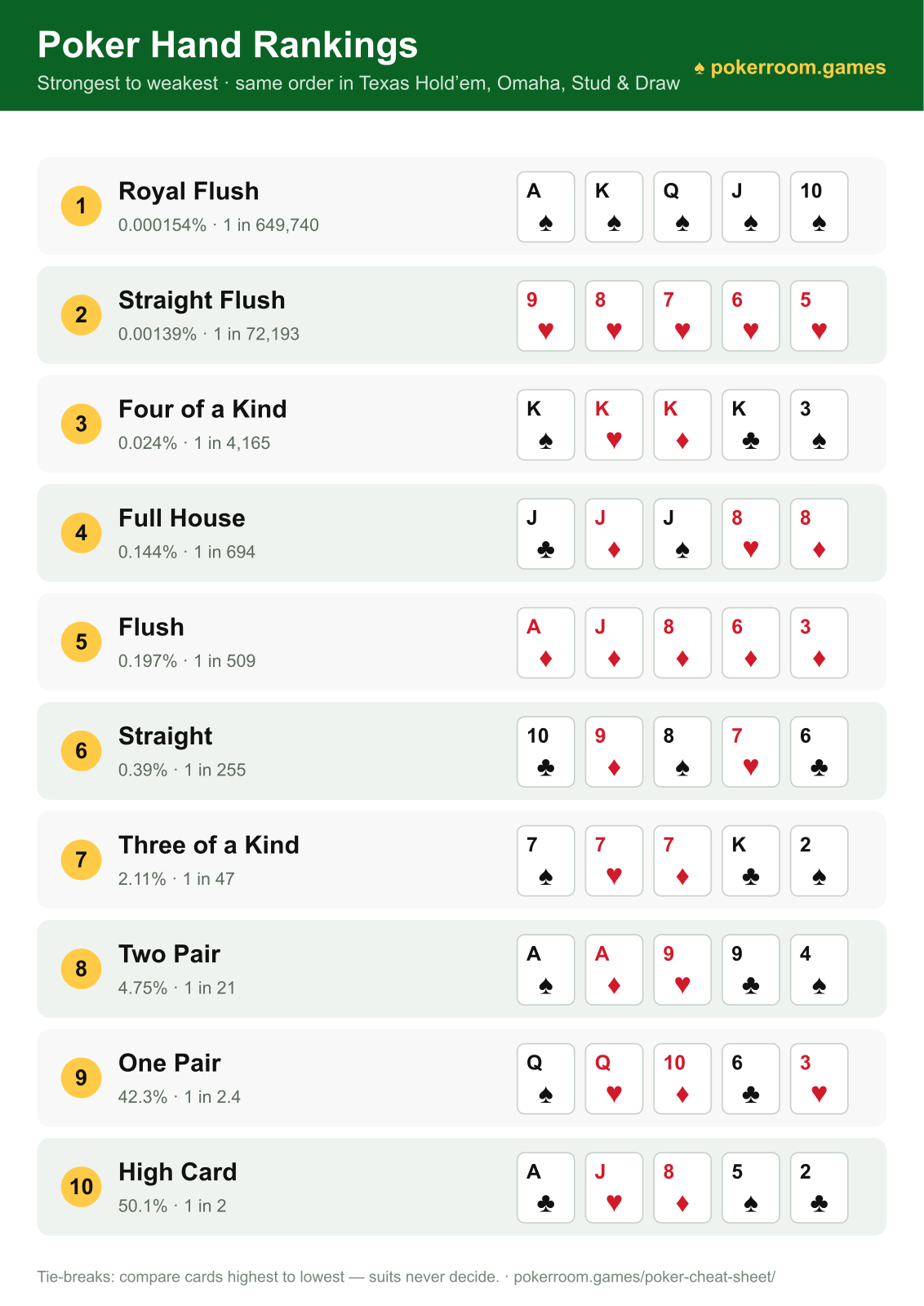
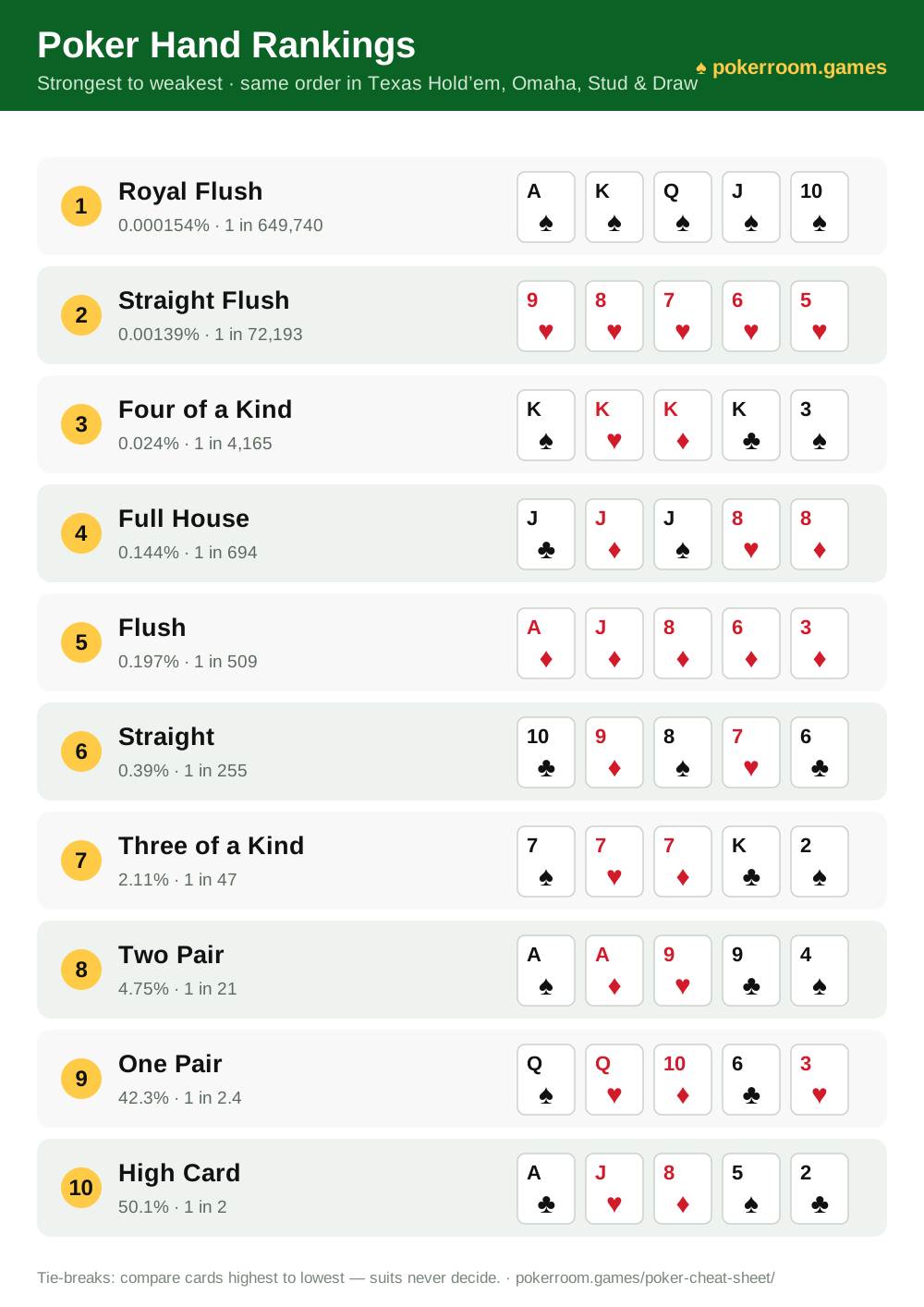
Hand Rankings · strongest → weakest
- 1Royal FlushA♠ K♠ Q♠ J♠ T♠
- 2Straight Flush9♥ 8♥ 7♥ 6♥ 5♥
- 3Four of a KindK♠ K♥ K♦ K♣ 3♠
- 4Full HouseJ♠ J♥ J♦ 4♠ 4♥
- 5FlushA♦ J♦ 8♦ 5♦ 3♦
- 6StraightT♠ 9♥ 8♣ 7♦ 6♠
- 7Three of a KindQ♠ Q♥ Q♦ 8♠ 5♥
- 8Two PairA♠ A♣ 7♥ 7♦ J♠
- 9One PairT♠ T♥ K♣ 6♦ 2♠
- 10High CardA♠ Q♥ 9♦ 5♣ 3♠
Pot Odds · equity needed to call
| Opponent bets | You need ≥ |
|---|---|
| ½ pot | 25% |
| ⅔ pot | 29% |
| ¾ pot | 30% |
| Full pot | 33% |
| 2× pot | 40% |
Starting Hands · 6-max open ranges
Open-Raise by Position
| Pos | Open |
|---|---|
| UTG | ~12% |
| MP | ~16% |
| CO | ~25% |
| BTN | ~45% |
| SB | ~40% |
How to Use Each Section
Hand Rankings
Ten hand types ranked highest to lowest. Royal Flush is the strongest possible hand (and statistically the rarest — you’ll see one once in ~30,000 hands). High Card is whatever you have when nothing else applies. The rankings work the same in Texas Hold’em, Omaha, and Stud — though Short Deck swaps Flush above Full House because flushes are rarer with the 36-card deck.
Position Quick Guide
Your seat at the table dramatically changes which hands are profitable to play. Under-the-gun (UTG, first to act pre-flop) plays the tightest range because every player still has to act behind you. The Button (BTN, last to act post-flop) plays the widest because you have positional information on every street. The guide above shows simplified opening ranges for 6-max tables; full-ring (9-handed) ranges are slightly tighter from each seat.
Pot Odds Calculator
When facing a bet, pot odds tell you what equity your hand needs for a profitable call. If the pot is $100 and your opponent bets $50, you have to call $50 to win $200 (the $100 already there + the $50 bet + the $50 you add). That’s 25% required equity — any hand winning more than 25% of the time is a call. The calculator above does this math for you instantly.
Outs Chart
An “out” is a card that will improve your hand to a winner. A flush draw has 9 outs (9 cards of the suit you need still in the deck). An open-ended straight draw has 8 outs. Drag the slider to see your probability of hitting on the turn, river, or by the river — the famous “rule of 4” (multiply outs by 4 on the flop for approximate flop-to-river %) works because of the math the chart shows you exactly.
Bet Sizing
Standard online No-Limit Hold’em sizings. The pre-flop opening size of 2.5-3× the big blind is industry standard online; live games tend to size up to 3-5× because of looser fields. C-bets at 50-66% pot are the modern default — large enough to fold out marginal hands, small enough to keep your range balanced.
Common Mistakes
Eight of the most common leaks at low-stakes online play. The single biggest profit-killer for most players is playing too many hands pre-flop — especially from early position. Tighten your starting range and most other “problems” (bad rivers, hard calls) shrink with it.
FAQ
Can I print this cheat sheet?
Yes. Tap the Print button at the top of the page. The print stylesheet hides the navigation, footer, and SEO article — you get a clean B&W version with just the six reference sections. Fits on 1-2 pages.
Are the ranges in the position guide for cash games or tournaments?
They're general-purpose 6-max ranges that work for both early-stage tournaments and standard cash games. Late-stage tournament ranges shift significantly as stack depth shrinks (push-fold becomes the key skill), and ICM considerations change calling ranges near the bubble. For sub-15 BB play, use a push/fold chart instead.
What's the difference between the Rule of 2 and Rule of 4?
Rule of 2: multiply your outs by 2 to get your approximate % to hit on the NEXT card. Rule of 4: multiply outs by 4 to get your approximate % to hit by the RIVER (only valid when you're still on the flop with two cards to come). Both are approximations — the Outs Chart above gives you exact percentages.
Do these tips apply to other poker variants?
Hand rankings apply universally (except Short Deck swaps Flush above Full House). Position guide is specific to Hold'em — Omaha plays much closer to ABC tight-aggressive because of the four-card hands, and Short Deck plays much looser because of the deck math. Pot odds, outs, and bet sizing math is universal across variants.
Why are there no specific hand ranges for SB and BB?
Small Blind and Big Blind play is more about responding to other players' actions than initiating. Pre-flop, SB has the worst position in the hand (acts first on every street) so a lot of "open" hands actually 3-bet vs button opens or fold vs UTG. BB defends very wide against late-position raises because the 1 BB already invested changes the pot-odds math. Full SB/BB strategy needs its own chart.
Practice the spots in this cheat sheet at our free Texas Hold’em table. Compute exact equity with our Poker Odds Calculator. Or size your bankroll for the stakes you want to play with our Bankroll Calculator.
What This Cheat Sheet Covers
This cheat sheet distills the three things that decide most Texas Hold’em hands: hand rankings (so you always know where you stand at showdown), starting-hand selection by position (which hands are profitable to enter the pot with and from where), and pot odds(whether the price you’re getting justifies chasing a draw). Get those three right and you will beat most low-stakes games.
As a beginner, keep the cheat sheet open in a second browser tab or print it out. During a hand, first check the hand-rankings block to confirm your made hand. Before calling a bet on the flop or turn with a draw, punch the numbers into the Pot Odds Calculator — it takes about five seconds. Between hands, glance at the position guide and ask “did I play a hand from early position that the table says I shouldn’t?” That self-review loop, even just twice a session, trains pattern recognition faster than reading strategy articles alone.
Pre-Flop Quick Rules
Most of your profit (or loss) at the poker table is decided before the flop. These rules cover the fundamentals that the position guide above is built on.
- Play tight from early position. Under-the-gun and the seats just after it are the worst spots at the table — everyone acts behind you. Stick to strong pairs (TT+), big aces (AJ+), and strong suited connectors. Borderline hands lose money here over time.
- Open wider as you approach the button. The Button is the most profitable seat in poker because you act last on every post-flop street. From the CO and BTN you can profitably open pairs down to 22, any ace, and most broadways — see the interactive Starting Hands chart for the full grid.
- Raise; don’t limp. Open-limping (calling the big blind instead of raising) gives away information, builds a weak pot, and leaves you out of position. A standard raise of 2.5–3× the big blind wins the blinds outright or lets you play a manageable pot in position.
- Fold weak offsuit hands. K7o, Q8o, J6o — these hands look appealing because of the high card, but they play poorly post-flop and are dominated when they do connect. Suited cards and connected cards have much better implied odds.
- 3-bet your premiums. When you hold QQ, KK, AA, or AK and there is already a raise in front of you, re-raise (3-bet). It builds the pot when you are ahead, denies good pot odds to drawing hands, and often wins the pot outright. Flat-calling large pairs from out of position is one of the most costly common mistakes.
The full ranking of starting hands is at Poker Hand Rankings. Cross-reference it with the position guide in the cheat sheet above whenever you are unsure whether a hand is worth playing from a given seat.
Post-Flop Quick Rules
Once the board is dealt, the three biggest levers are position, pot odds vs. draws, and bet sizing. Here is the short version:
- Use your position. If you are last to act, you have maximum information — you know what everyone else did before you decide. Check more often when you are out of position (acted first) and bet more freely when you are in position (acted last). Position is worth more than most beginners realize.
- Continuation-bet selectively. A c-bet (betting the flop after raising pre-flop) at 50–66% of pot is effective on boards that favor your pre-flop range (high-card-heavy, dry boards). On wet, low-connected boards that miss your range but hit your caller’s, mixing in checks is often more profitable than auto-betting.
- Price your draws correctly. Before calling a bet with a flush or straight draw, use the Odds Calculator or the Pot Odds Calculator above. A flush draw has roughly 35% equity to the river — if you are paying more than 35% of the pot to continue, the call loses money in the long run. Discipline here separates winning players from break-even ones.
- Know when to fold top pair. Top pair is not the nuts. On a board like A♣ J♠ T♥ facing a raise from a tight player, TPTK (top pair top kicker) is often beaten. Ask: what hands does this player raise here? If the realistic range beats you most of the time, top pair is a fold — even though it feels like a strong hand.
- Bet the right size for your goal. Thin value bets (targeting worse hands that call) work best at 40–60% pot. Bluffs that need to fold out strong hands need a larger size (75%+). Matching your sizing to your goal instead of betting a fixed fraction is an immediate edge at low stakes.
How to Memorize the Hand Rankings
The core insight is simple: rarity equals strength. The harder a hand is to make, the higher it ranks. A Royal Flush comes around once in roughly 30,000 hands — so it beats everything. High Card occurs in about half of all dealt hands — so it loses to everything else. Once that principle clicks, you stop memorizing a list and start understanding a ranking.
A useful grouping is made hands vs. draws.Made hands — pair, two pair, three-of-a-kind and above — are complete right now and usually can be bet for value. Draw hands (flush draw, straight draw) are incomplete and need another card. Beginners sometimes overplay draws as if they were already made; the cheat sheet’s Outs Chart shows exactly how often a draw completes, which keeps expectations calibrated.
A quick mnemonic for the top five: “Really Strong Full Flushes Straight.” That maps to Royal Flush, Straight Flush, Four of a Kind (Full rhymes loose but think “four”), Full House, Flush, Straight. From there, the bottom five follow naturally: Three of a Kind, Two Pair, One Pair, High Card — each one obviously weaker than the last. See the full hand rankings page for examples of every hand type with card glyphs and tiebreaker rules.
Sources & Methodology
The hand rankings and starting-hand ranges follow standard Texas Hold'em references, including Wikipedia's canonical list of poker hands and established opening-range theory; all ranges have been cross-checked against the free game's showdown logic on this site to confirm consistency.
Sources
Written and maintained by Yoda Games Studio — an independent game studio with years of experience building free-to-play games including Pachinko Rush and Crash or Cash. We review and update our poker guides regularly for accuracy.